Decorating with Drawings: Daniel Maclise in John Forster’s Library
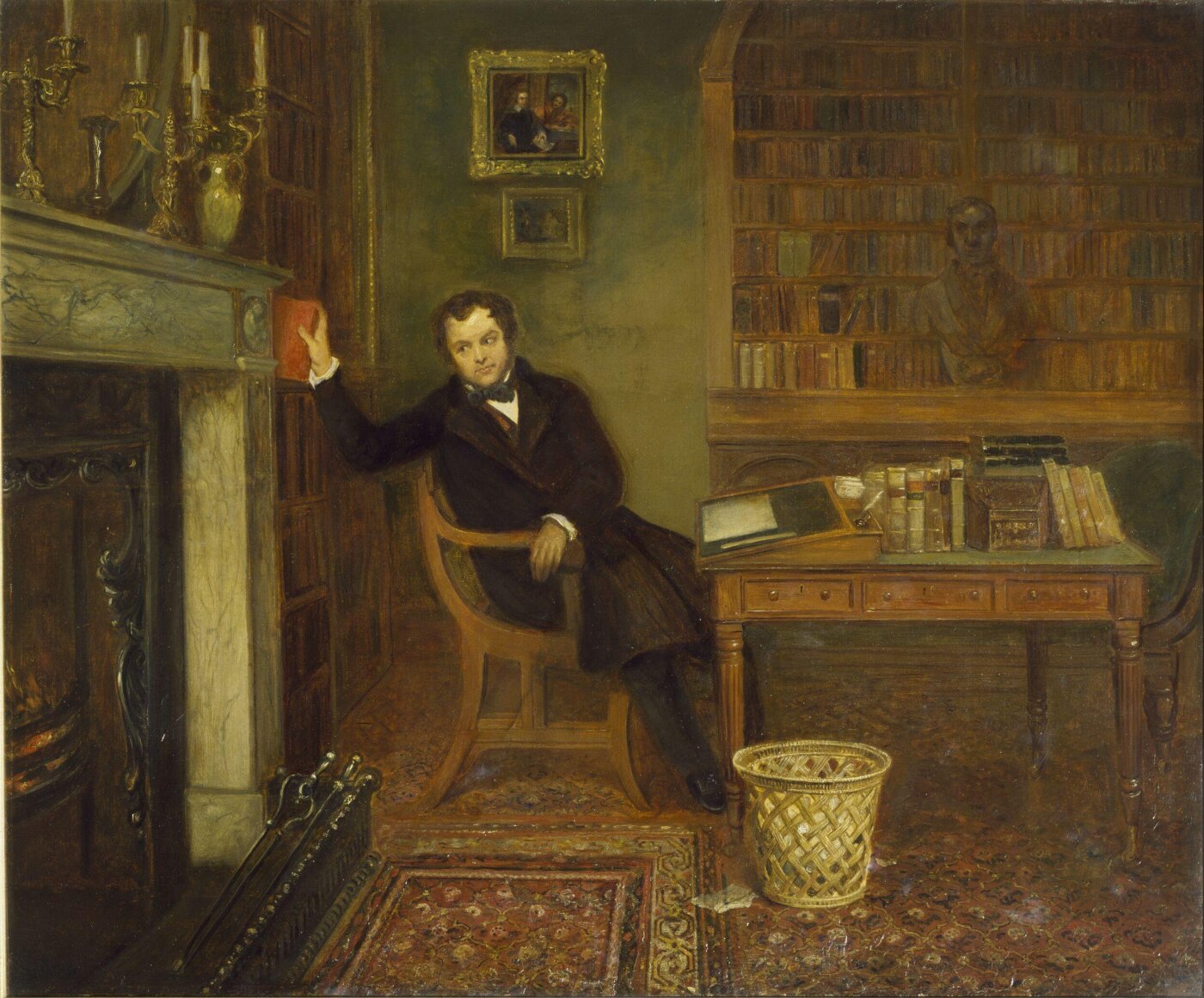
Edward Matthew Ward, “John Forster in his Library,” c. 1850, oil on canvas, V&A.
Just how bleak was Bleak House? Charles Dickens found inspiration for his atmospheric novel, published in 1852, in the intensely cluttered library of his closest friend and biographer, John Forster. Forster spent more than two decades in chambers at 58 Lincoln’s Inn Fields, a space packed from floor to ceiling with dark wooden bookshelves, furniture, and prized oil paintings like Daniel Maclise’s Caxton Showing the First Specimen of His Printing to King Edward IV at the Almonry, Westminster. This environment inspired Dickens to use it as the model for the sinister lawyer Mr. Tulkinghorn’s home in Bleak House. In the novel, the packed shelves and heavy furniture contributes to an atmosphere of entrapment, emphasizing the lawyer’s role as a manipulator. As depicted by his friend Edward M. Ward, however, Forster’s library appears to be a cosy space of work and reflection, a cheery fire warming the room with silver adoring the mantel and books within easy reach of the desk. But it was, without a doubt, packed from floor to ceiling with books. Forster later moved to a new house in Palace Gate, which allowed him to replace the cluttered chaos of his former residence with a custom layout featuring purpose-built galleries and a legendary fire-proof library.
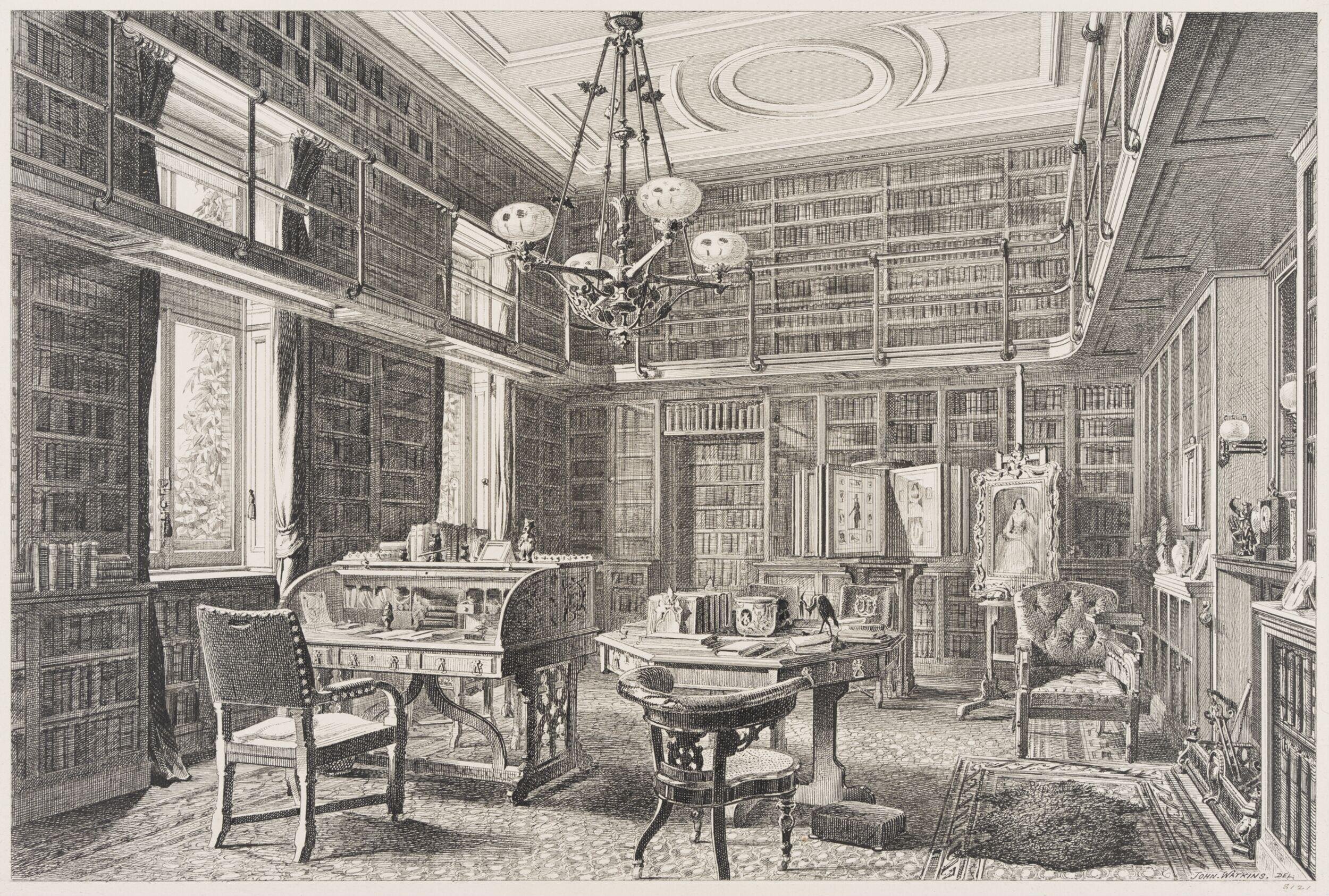
John Watkins, “View of the library of the late Mr. John Forster,” c. 1876, pen and ink drawing, V&A
To bring this expanded vision to life, Forster purchased the freehold plot in June 1862 for £1,800 from the prominent building firm W. Cubitt and Company. Completed in 1864, the new house featured an unremarkable exterior, but the interiors were tailored entirely to Forster’s literary pursuits. He planned the home around his collection of art and literature. The crowning jewel of his design was an expansive library designed to securely house his collection of manuscripts, complete with a specialized fire-proof strongroom. He owned more than 18,000 books, pamphlets, and historical manuscripts that he bequeathed to the nation via the South Kensington Museum (now the V&A Museum). The library comprehensively covered English literature, history, and drama, with historical correspondence and papers from prominent figures like Oliver Cromwell, David Garrick, and Samuel Johnson. Its most prized objects were the original handwritten manuscripts and corrected proofs of Dickens’s novels, including Oliver Twist, David Copperfield and Bleak House, as well as the incomplete The Mystery of Edwin Drood, which Dickens had left to Forster as his literary executor. The collection’s other highlight is the Codex Forster, a set of three original notebooks belonging to Leonardo da Vinci that contain the artist’s personal sketches and musings on topology and geometry. Surrounded by his carefully organized shelves and prized artifacts, Forster spent his final decade in this sanctuary, where he wrote his authoritative biography, The Life of Charles Dickens.
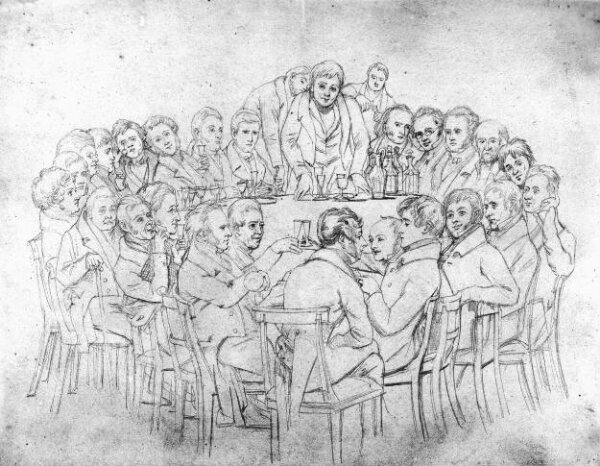
Daniel Maclise, Preliminary drawing for the group caricature, ‘The Fraserians,’ c. 1835, V&A.
Along with Dickens, John Forster and the Irish painter Daniel Maclise shared a lifelong friendship, with Forster serving as the artist’s close confidant and literary advisor. Following Maclise’s passing, Forster preserved a massive collection of the artist’s visual works. They range from squared-up preparatory drawings for oil paintings to quick pencil sketches done during their travels together. It also included a number of Maclise’s character studies for Fraser’s Magazine. By 1830, he was responsible for the portraits that accompanied the magazine’s “Gallery of Illustrious Literary Characters” feature, usually written by the magazine’s editor (and fellow Irishman) William Maginn. The magazine established Maclise as an artist in a cultural and literary milieu that included Benjamin Disraeli and Edward Bulwer-Lytton. The artist would also contribute his own poetry to the magazine. In the 1835 compendium known as “The Fraserians,” Maclise shows many of the magazine’s contributors convened at the table of Maginn, who stands at the back behind empty decanters. Throughout, Maclise exaggerates some features to lend legibility and conviviality to the image. For example, directly opposite Maginn, the broad forehead of the folklorist Thomas Crofton Croker come into view as he reaches to toast with the Scottish Army doctor and adventurer William Dunlop. Croker’s receding hairline provides a humorous contrast to the elegantly flowing locks and prodigious sideburns of Hugh Fraser, the founder of the magazine who is in the act of slipping a copy of Fraser’s Magazine into his back pocket.
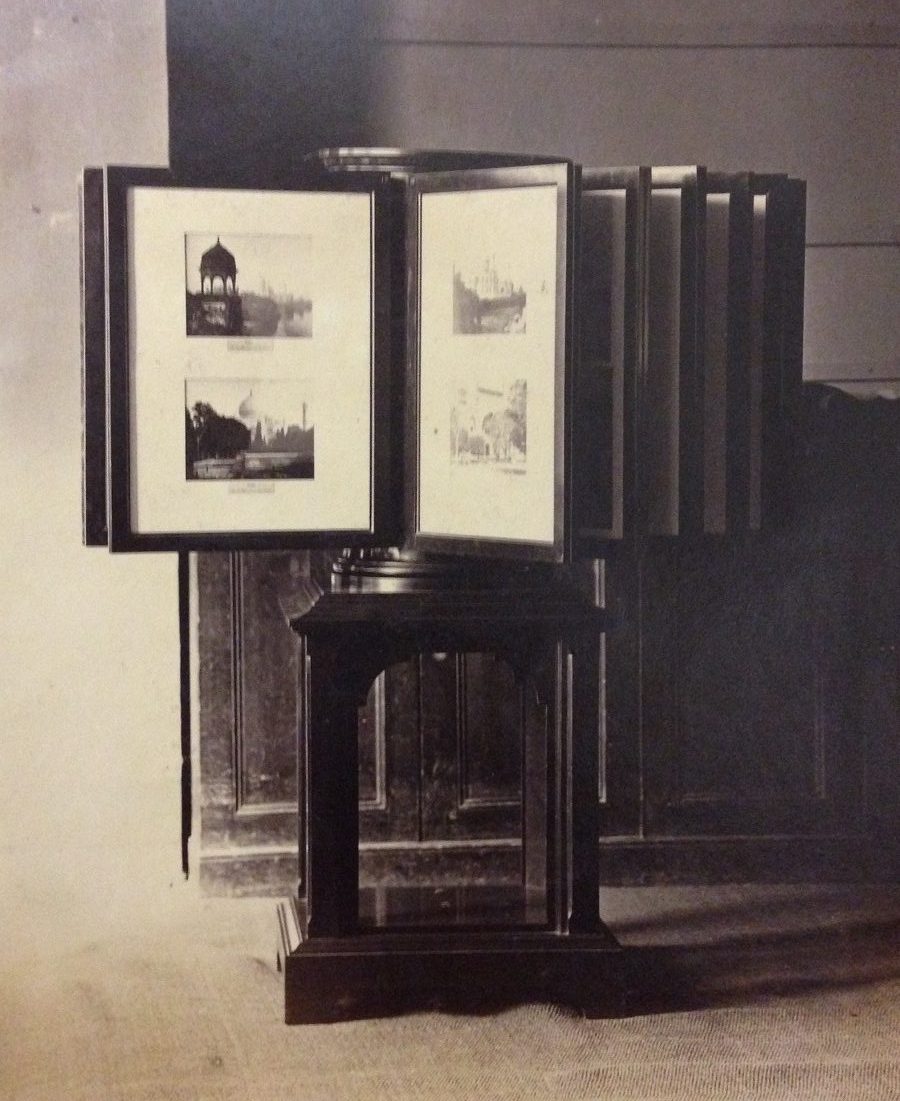
Pillar stand designed by Henry Cole, undated photograph, V&A Archives.
When I went to the V&A study room last year to look at Maclise’s drawings, I noticed a note in the catalogue stating that most of the Maclise drawings from the bequest arrived at the museum in a “pillar stand of thirty frames, containing three hundred and ninety drawings and sketches in pencil, pen and ink, and colour – figures, landscapes, etc. There are also seven by other hands (aside from Maclise) – Calderon, T.S. Cooper, Cope, Herbert, and Landseer, all R.A., F. Danby, A.R.A., and G. Cattermole.” A closer look at John Watkins’s sketch of the library at 1 Palace Gate reveals the vertical stand, visible in the right background, just behind the writing table. It seems likely that Forster adapted this mode of display from Henry Cole, the first director of the South Kensington Museum, which wasn’t far from Palace Gate. As Nicholas Smith has noted in his fascinating history of the display cases, Cole wrote in his diary in 1866 that he was working on a prototype of a “radiating pillar frame,” and he contributed an example to the Paris World’s Fair of 1867 as “radiating frames for exhibiting drawings, prints, etc.” According to Smith, Cole intended for his designs to be “non proprietary,” stating “any cabinet maker is free to make them.”
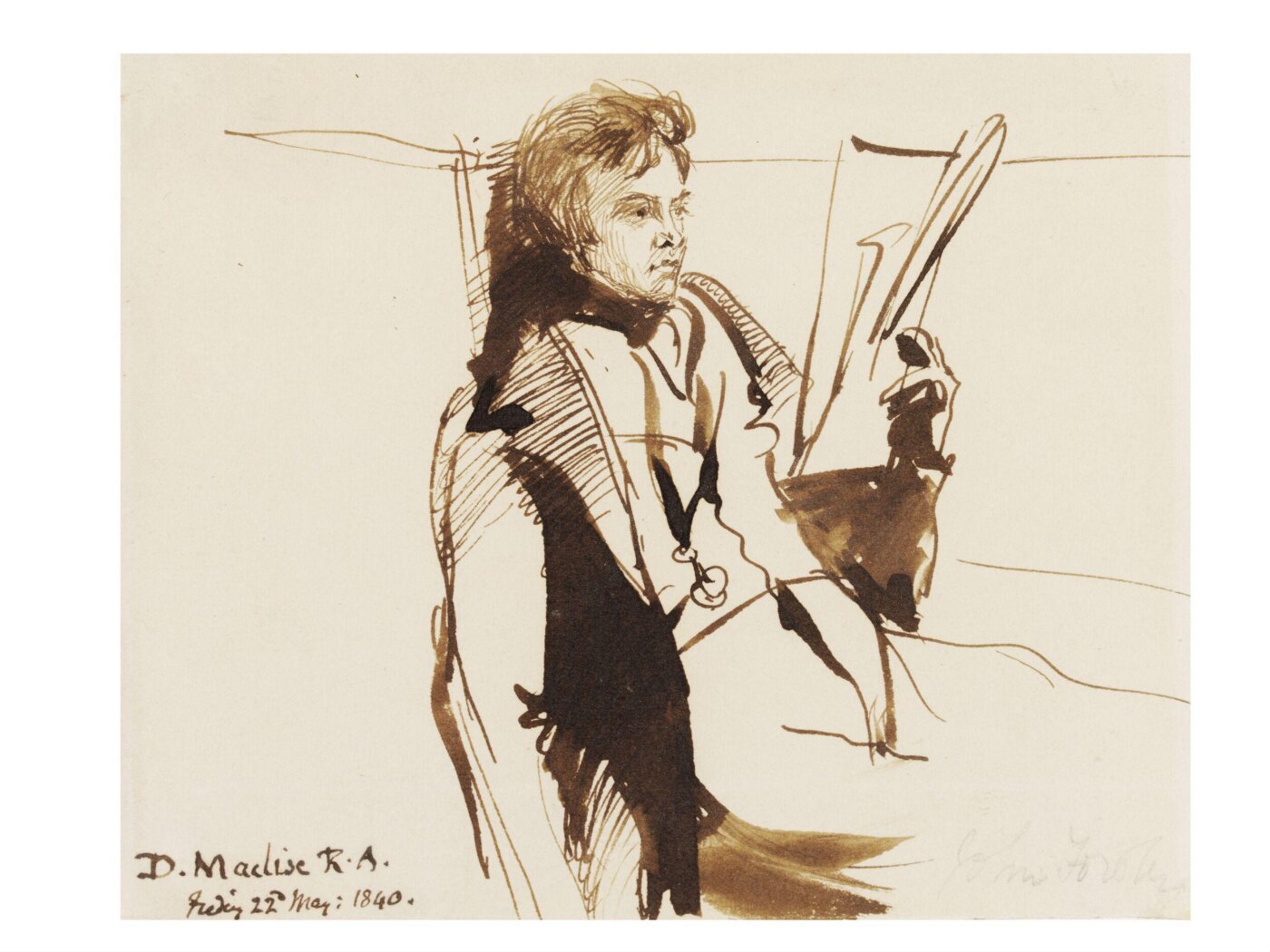
Maclise, pen sketch of John Forster, c. 1840, V&A.
It is fascinating to think about how the pillar functioned in Forster’s library, displaying a selection of some 390 works by Maclise, including the artist’s own affectionate portrait sketch of Forster from 1840. The collection also includes numerous portrait sketches of Dickens and other friends, suggesting that the stand functioned, at least in part, like a vertical scrapbook. Rather than simply presenting Maclise’s work, it displayed a visual record of Forster’s social and artistic world, turning the library into a space of memory and commemoration. The juxtaposition of portraits and sketches of friends with other studies by Maclise makes the stand feel less like a conventional display object and more like a map of Forster’s own relationships, with Maclise at its center. Bound by his commitment to national heritage (he was a central figure in purchasing and saving “Shakespeare’s Birthplace” in Stratford-Upon-Avon), Forster included his collection of Maclise’s drawings in his bequest. In doing so, he transformed a deeply personal collection into a form of cultural inheritance, preserving not only Maclise’s work but also a visual record of the friendships and intellectual networks that shaped Forster’s life. The pillar thus occupied an intriguing space between private remembrance and public heritage, carrying the intimate associations of a scrapbook into the institutional realm of the museum.
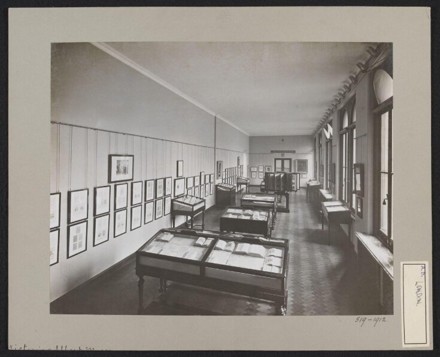
Gallery displaying items from the John Forster Bequest, after 1888, V&A.
I’ve been unable to determine whether or not the museum took full possession of the original pillar stand along with all 397 drawings mounted inside it. There is an archival photograph showing the Forster Bequest on display, complete with pillar stand in the background. However, because permanently displaying these delicate pencil sketches upright causes severe fading and paper degradation, museum conservators eventually unmounted the artwork from the swinging frames. Today, the individual Daniel Maclise drawings are safely stored in flat, climate-controlled archival boxes within the V&A’s prints and drawings department. The decision highlights an inherent tension between preserving the drawings and preserving the historical circumstances in which they were displayed. While the flat storage protects Maclise’s fragile works, it also makes it more difficult to recover the intimate, almost scrapbook-like quality of Forster’s original arrangement.
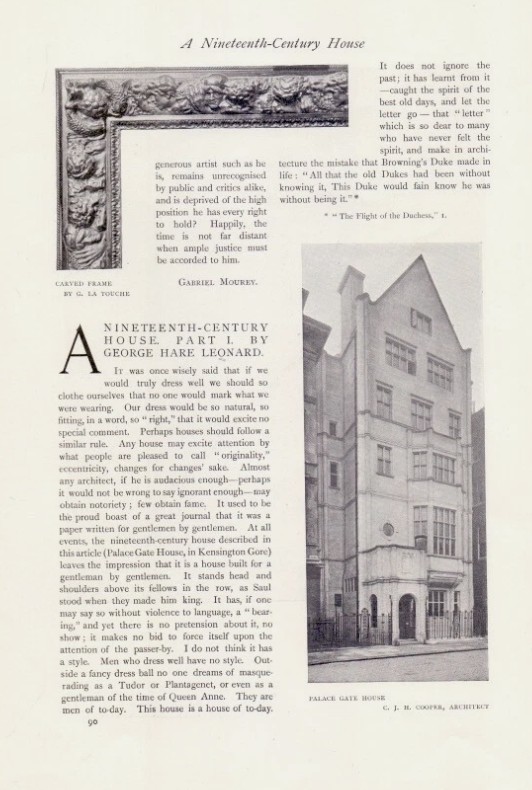
George Hare Leonard, “A 19th Century House.” The Studio, vol. 16, 1899, pp. 91–100.
1 Palace Green continued to garner public interest into the early twentieth century, although not as a great literary and artistic repository. Following his death in 1876, his widow Eliza Ann Coburn Forster preserved this remarkable interior for nearly two decades, keeping his aesthetic legacy intact until 1894. Just two years later, the property was completely demolished to make way for a progressive new era of design. Between 1896 and 1898, Arts and Crafts architect C. J. Harold Cooper entirely reimagined the site, replacing the traditional Cubitt layout with a towering, avant-garde townhouse. While Forster’s legendary rooms were physically lost to history, the site maintained its reputation for design, with The Studio magazine praising the townhouse as a triumph of modern architecture. Forster’s vision of 1 Palace Green disappeared, alongside his idea of the house as a carefully composed environment of art, books, and personal associations. The objects survive elsewhere, and the destruction of the house marked not the transformation into his collection of objects, memories, and records into a bequest preserved beyond the walls he had created for them.