#curated decay, “Curated Decay” and the Country House
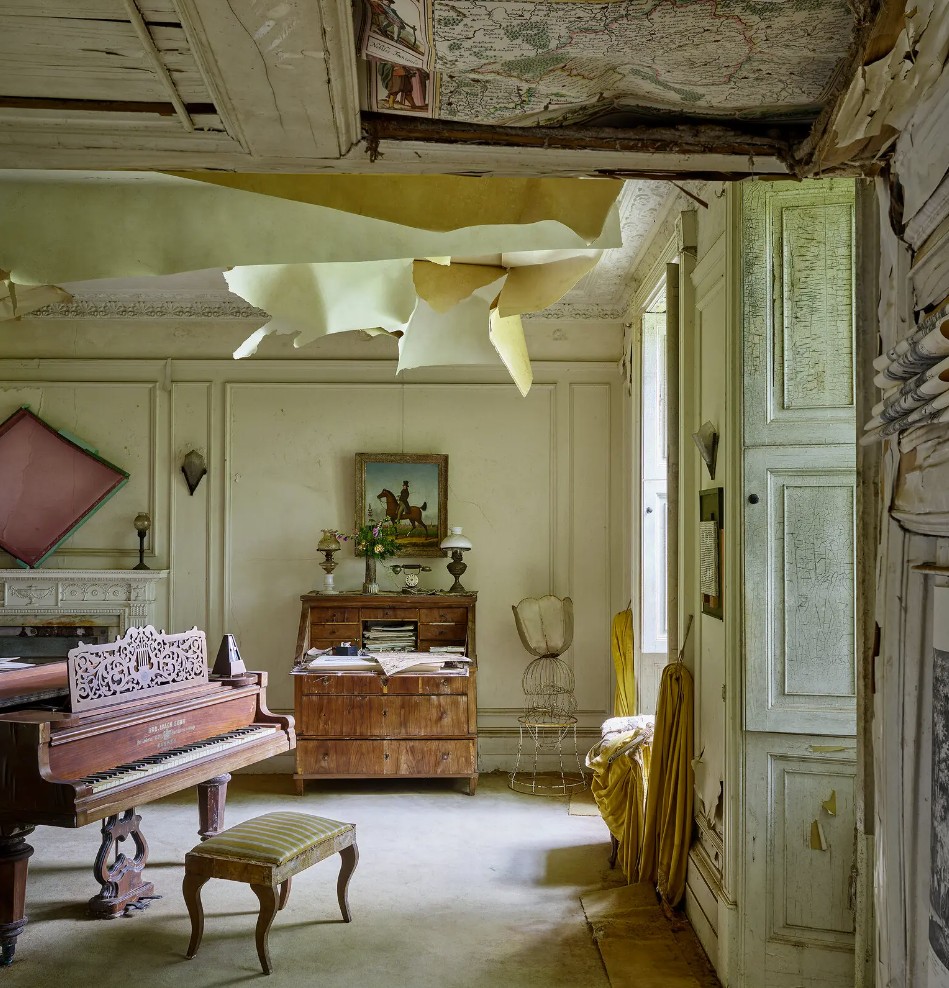
In the drawing room of the von der Becke family’s home in the English countryside, a Rud. Ibach Sohngrand piano that was a gift from a houseguest. Reproductions from the print collection of the home’s late owner, Bernhard von der Becke, are nestled in the doorway leading into the room. The mixed-media piece above the 18th-century fireplace and the wire lampshade sculpture by the window are both by the South African-born artist Helena Pritchard. Photograph by Henry Bourne. Artwork above fireplace: Helena Pritchard, “Aperture Painting,” 2021 © Helena Pritchard, courtesy of the artist; sculpture on floor, rear right: Helena Pritchard, “Ephemeral Assemblage,” 2023 © Helena Pritchard, courtesy of the artist.
A recent feature in T: the New York Times Style Magazine explored “a home that became lovelier the more it fell apart.” The story is, on its surface, one about the English countryside house that time forgo: a circa 1690 Stuart manor on the South Downs, 50 miles outside London with peeling walls, no heating beyond the fireplace, and a collapsed greenhouse. In 1975, the German print dealer Bernhard von der Becke and his wife Blanka saw this listing in a British newspaper and fell in love with an idyllic vision of English country life. They were not interested in renovating the property. The current state of the house is not the residue of centuries of English gentry, but a record of eccentric and artistic lives.
Artist Helena Pritchard, who has done several residencies there and whose sculptures now inhabit the rooms alongside Bernhard’s stacked prints, puts it precisely: “This is a house that’s beautiful, but there’s a precariousness to it. That makes it magical.” The precariousness is the point. Pritchard makes work from the house’s own discarded materials, its plaster friezes and felled trees and tins of circa-1920s paint found in an outbuilding. The notion of #elegantdecay or #curateddecay fills many an Instagram feed or Pinterest board. Posts that range from images of dying tulips to close-ups of exposed brick evoke this particular kind of longing for the passage of time. The house is its own archive.
This feature got me thinking about the origins of “curated decay” in relation to the domestic interior in Britain. The term was coined by Caitlin DeSilvey, a geography professor at the University of Exeter, in her book Curated Decay: Heritage Beyond Saving (University of Minnesota Press), published in 2017. In the book, DeSilvey visits sites experimenting with “curated ruination,” exploring how an acknowledgement of the ephemerality of artifacts and architecture can create a particular kind of cultural memory. At times melancholy and provocative, DeSilvey argues that we “need ways of valuing the material past that do not necessarily involve accumulation and preservation.” As the Institute for Historic Building Preservation has pointed out, this approach finds a parallel in the “re-wilding” to encourage the habitation of native wildlife and the effects of natural forces. It is no coincidence that the English relationship with decay as a deliberate aesthetic began in the garden. By the 1740s, English landowners had grown disenchanted with the clipped formality of the French and Dutch traditions and theorists like William Gilpin advocated for “picturesque” garden scenes that resembled landscape paintings: irregular, textured, shot through with melancholy grandeur. In this case, however, newly-built yet crumbling follies appeared as constructed decay. While the ghost of the picturesque hovers over #curateddecay and the related practice of “ruin photography,” advocates of “curated decay” are motivated by very real concerns about climate change and the need to adopt more sustainable practices. As Michael R. Allen noted in a perceptive review of DeSilvey’s book, historical preservation should accept decay “not simply for its optical allure, or for an admission of the futility of restoration, but because of the empirical evidence of the benefits of biodiversity.”
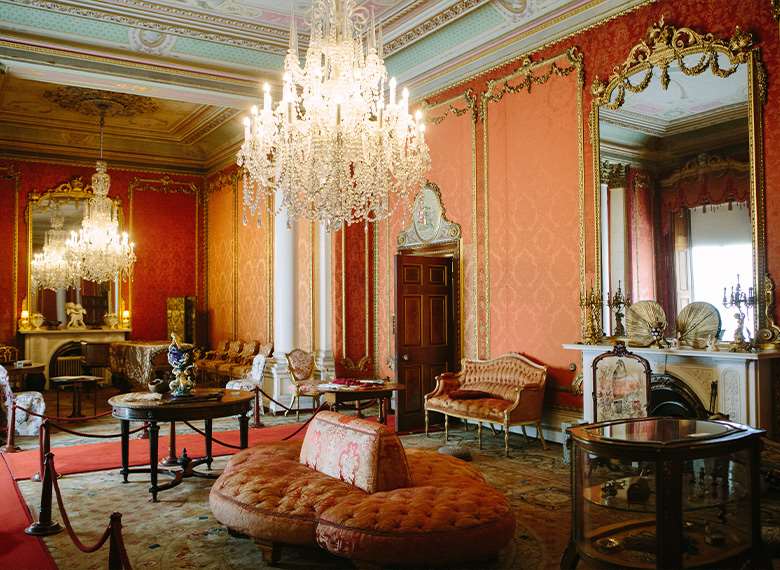
Drawing Room, Brodsworth Hall, Yorkshire.
While this philosophy may be familiar to visitors of Drayton Hall outside Charleston, South Carolina, it seems to be less popular in the UK, especially at homes and country estates managed by the National Trust or English Heritage. For example, the National Trust purchased Tyntesfield Park outside Bristol in 2002 for more than £17 million after a major fundraising campaign to “save” the house for the nation. Afterwards, they engaged in an extensive restoration project billed as “a return to grandeur.” English Heritage staged their invention at Brodsworth Hall in South Yorkshire as a quandary: “to conserve or restore? That is the question.” That was indeed the question as the scale of the disrepair when the house came into their hands in 1990 prompted a reconsideration of the original plan to restore the home. What they settled on was a combined approach, where ground floor Victorian interiors were treated with a “restoration” philosophy in mind while the remainder of the house was treated with a “conservation” mindset. The website for Brodsworth House sells this approach as more authentic and more interesting for the visitor, noting that,
The last owner, the indomitable Sylvia Grant-Dalton, fought a losing battle against subsidence and leaking roofs, making do and mending with dwindling funds and ever-fewer servants . . . the mansion remains as she left it: not a manicured Downton Abbey fiction but a country house as it really was.
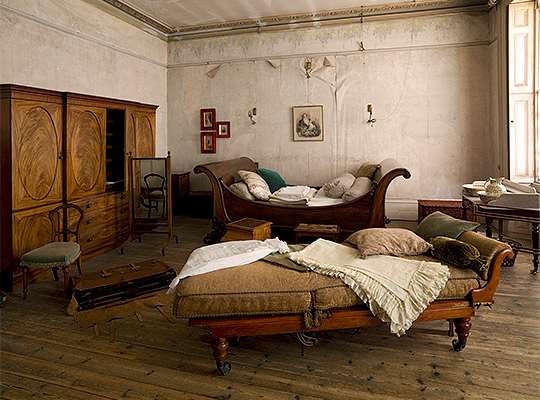
“The principal guest room at Brodsworth, which fell out of use in the 20th century, retains its abandoned air,” as noted on the English Heritage website.
In the case of the domestic interior at Brodsworth House and elsewhere, “curated decay” is also a story of aristocratic continuity and aristocratic decline: the great house, the dwindling fortune, the threadbare carpet that stays threadbare because there is no money left to replace it and no servants to repair it. The long economic squeeze on the country house, from the time that estates began to complete with cheap North American grain in the 1870s to raising income tax in the early twentieth century (the rate increased from six percent in 1914 to thirty percent by 1918), produced a vast amount of genuine, unintended decay inside England’s grandest rooms. The Second World War completed what the first had started. Houses were commandeered, often returned to their owners in poor repair, and they were subject to building restrictions that prioritized post-war reconstruction elsewhere. By the 1950s, a vast amount of genuine and unintended decay existed inside England’s grandest houses.
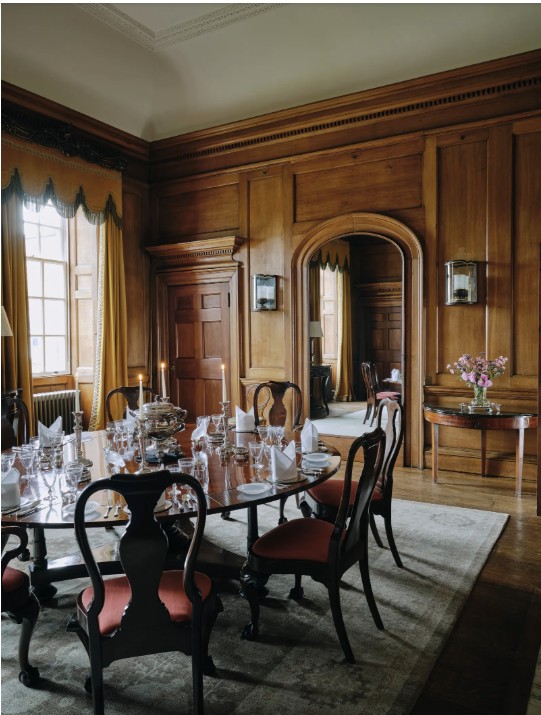
Dining Room at Radbourne Hall, Derbyshire, with its original 18th century oak paneling, stripped and waxed by Fowler. Image from “House and Garden.”
With the creation of the design firm Colefax and Fowler, what had begun as inability became indistinguishable from taste. Sibyl Colefax founded the design firm in 1934, and John Fowler came on board in 1938. In 1944, Colefax retired and sold her part of the business to Nancy Lancaster, an American heiress who had also watched her own fortune disappear in the 1929 crash. Fowler’s philosophy of designed related to variety and informality ways that recalls picturesque theorists like Gilpin. He noted that “decoration is a logical compromise between comfort and appearance. A room must be essentially comfortable not only to the body but to the eye.” This notion of “comfort to the eye” led Fowler to selectively distress paint finishes, use fabrics already beginning to fade, and arrange rooms so that their imperfections seemed inevitable rather than accidental. Fiona McKenzie Johnston makes the case for the importance of Fowler’s work in this article for House and Garden. For her part, Lancaster declared, “I can’t bear anything that looks like it’s been decorated.” While she never used the term “comfortable, shabby chic,” it is often associated with their work, and I can attest to the fact that the phrase made it all the way to suburban St. Louis in the 1980s, where I could find the “how to” for distressed finishes in Jocasta Innes’s Paint Magic to recreate the interiors featured in the pages of Victoria magazines. There is a difference, however, between the sponge painting of “shabby chic” and #curateddecay. While Fowler was using surplus army blankets to create new curtains for Clandon Park in Yorkshire in the 1940s, the aesthetics of curated decay, at least to judge by Instagram, suggest that the old curtains should be left to disintegrate in place. Ironically, Clandon Park itself is now at the center of debates about restoration.

The charred remains of Clandon Park House after a fire that destroyed much of the property in April 2015. © Chris Lacey / National Trust Image.
The eighteenth century Palladian mansion, seat of the Earls of Onslow, was given to the National Trust in 1956. An electrical fault in the basement began a fire in April 29, 2015 that left only one room intact. It is estimated that 80% of the collection, including paintings and historic furniture, was destroyed. As Helen Ghosh, director general of the National Trust at the time of the fire noted, “the house is now essentially a shell.” In 2016, the Trust announced that they would fully restore the ground floor rooms to their 18th century design, with upper floors providing space for events rather than restored interiors. However, in 2022, they reframed this plan, stating that they would restore the one surviving room–The Speaker’s Parlour–and stabilize the rest of the house in its ruined state, preserving the destruction for visitors. In January 2026, a group called “Restore Trust” began working to stop this plan through judicial review, demanding that the National Trust return to the restoration plan outlined in 2016. In presenting their argument to the public, Restore Trust emphatically reject what they see at the National Trust’s view that “any substantial restoration is philosophically unsound.” In The Seven Lamps of Architecture published in 1849, John Ruskin argued that the “golden stain of time” on a building was irreplaceable. Age and weathering were sources of beauty and meaning that no restoration could recover. Architect and theorist Ryan Roark has provided a fascinating overview of Ruskin’s position on this issue in relation to twenty-first century architectural practice. For Ruskin, the desire to renew was, in fact, a form of destruction, a philosophy that prompted the establishment of the Society for the Protection of Ancient Buildings (SPAB) in 1877 by William Morris and Philip Webb. When a building is at its end, Ruskin entreats us to “throw its stones into neglected corners, make ballast of them, or mortar, if you will; but do it honestly, and do not set up a Lie in their place.” In a design culture that has become very good at manufacturing the appearance of a life fully lived — stonewashed linen, deliberately scuffed leather, artfully imperfect plaster — the sites featured on #curateddecay nevertheless seem to offer to the real thing: the beautiful, precarious residue of time.