Venice on the Walls of Wiltshire: Clarkson Stanfield at Bowood House
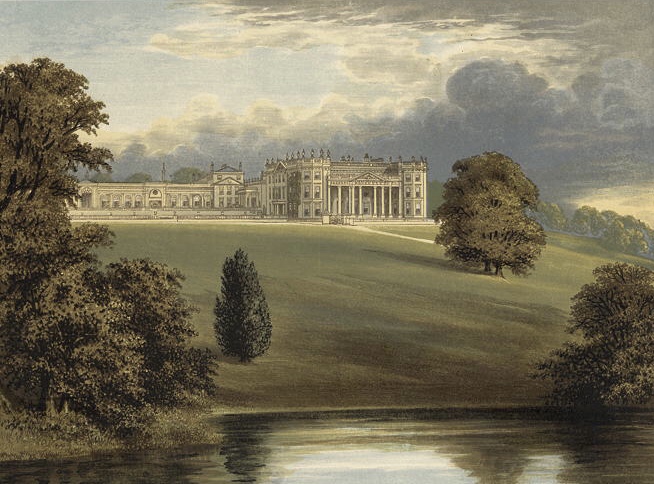
Bowood House from Morris’s County Seats (1880). The block on the right is the “Big House,” demolished in the 1950s. The wing on the left, starting with the short tower, remains. Wikipedia.
One of the central questions that animates “Home Subjects” is how collectors thought about the relationship between a room and the paintings hung within it. The Venetian pictures that Clarkson Stanfield (1793–1867) painted for the Great Drawing Room (later used as the dining room) at Bowood House in Wiltshire offer an unusually rich and poignant case study, as the room does not survive in its original context and the paintings remain untraced. Or so it seems.
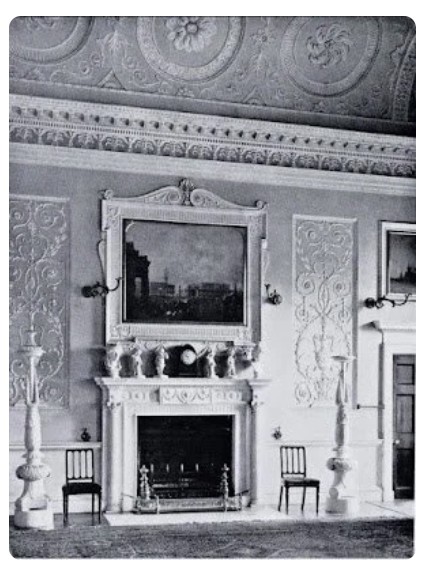
One of the few photographs of the Great Drawing Room (later Dining Room) at Bowood House showing Clarkson Stanfield’s paintings.
Sir Henry Petty-Fitzmaurice, 3rd Marquess of Lansdowne (1780-1863) ordered the first of ten pictures Stanfield was to paint for Bowood between 1833 and 1845. As Pieter van der Merwe pointed out, the origins of this commission remain unknown. (His The Spectacular Career of Clarkson Stanfield, 1793-1867: Seaman, Scene-Painter, Royal Academician, the catalogue of a 1979 exhibition at the Tyne and Wear County Council Museums remains the standard reference work on the artist). Stanfield came to painting by an unconventional route, having first served as a merchant sailor and then in the Royal Navy before a hand injury brought his seafaring career to a close. Working alongside (and later in competition with) David Roberts at Drury Lane, he helped revolutionize theatrical scene painting, elevating it from a purely functional craft into a discipline with genuine artistic ambitions. He was able to combine his knowledge of the sea with a command of large-scale pictorial composition.
The commission arrived at a pivotal moment in Stanfield’s career: he had only recently been elected a full Royal Academician, and his work was in considerable demand among aristocratic collectors. Stanfield executed two notable series of Venetian subjects: one for Bowood House, the other for the Duchess of Sutherland at Trentham Park in Staffordshire. Neither of these carefully conceived decorative programs survive. Trentham Park was demolished in the early twentieth century, and the paintings were sold at Christie’s in 1908. These paintings also remain untraced.
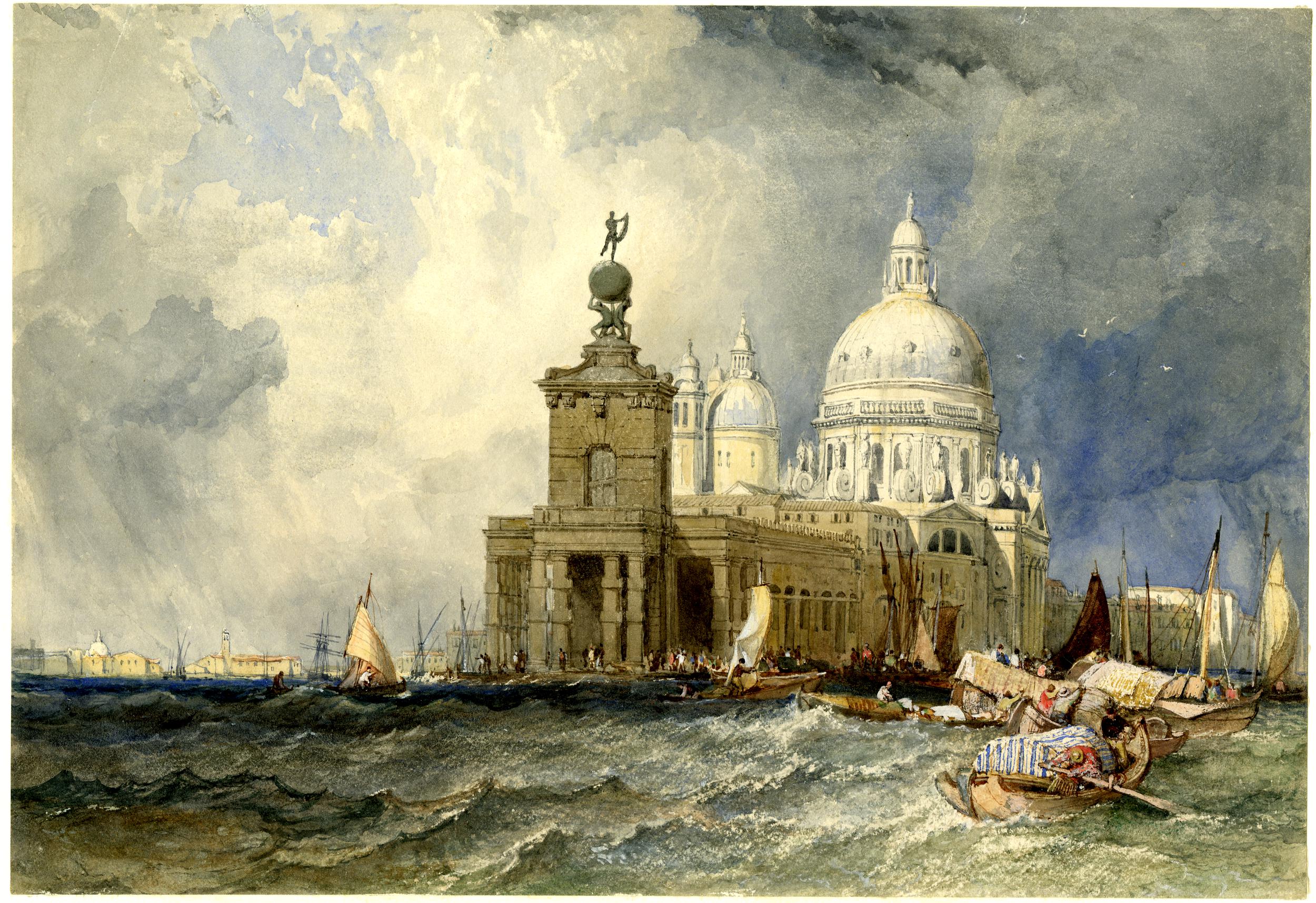
Clarkson Stanfield, “The Dogana and church of the salute, Venice,” watercolor, c. 1830. British Museum. This watercolor, based on sketches that the artist made during a trip to Venice in 1830, likely bears a close resemblance to the oil painting.
The Great Drawing Room at Bowood was no ordinary space. It was designed by Robert Adam, and Stanfield’s Venetian canvases were designed to inhabit that neoclassical setting with an appropriate sense of grandeur. Stanfield’s depiction of play of light on water with Venice must have harmonized with the light blue color scheme of the room. His views provided vistas of the city, alternating with Adam’s decorative plasterwork motifs. Views of the room from the National Monuments Record suggest that the ten canvases were of at least four different sizes, with smaller views above the doorways, and then a larger view holding the space of the main wall between the doorways. When compared with the current configuration of Adam’s decorative scheme, it seems that the paintings would have adorned three walls, with the fourth wall made up of windows. Gustav Waagan’s Art Treasures of Great Britain (1854) notes that the room also included two paintings, one of Rome and the other of Tivoli, by Charles Eastlake. He does not enumerate the views of Venice by Stanfield, although he does note that “the effect of the whole apartment is highly agreeable.”
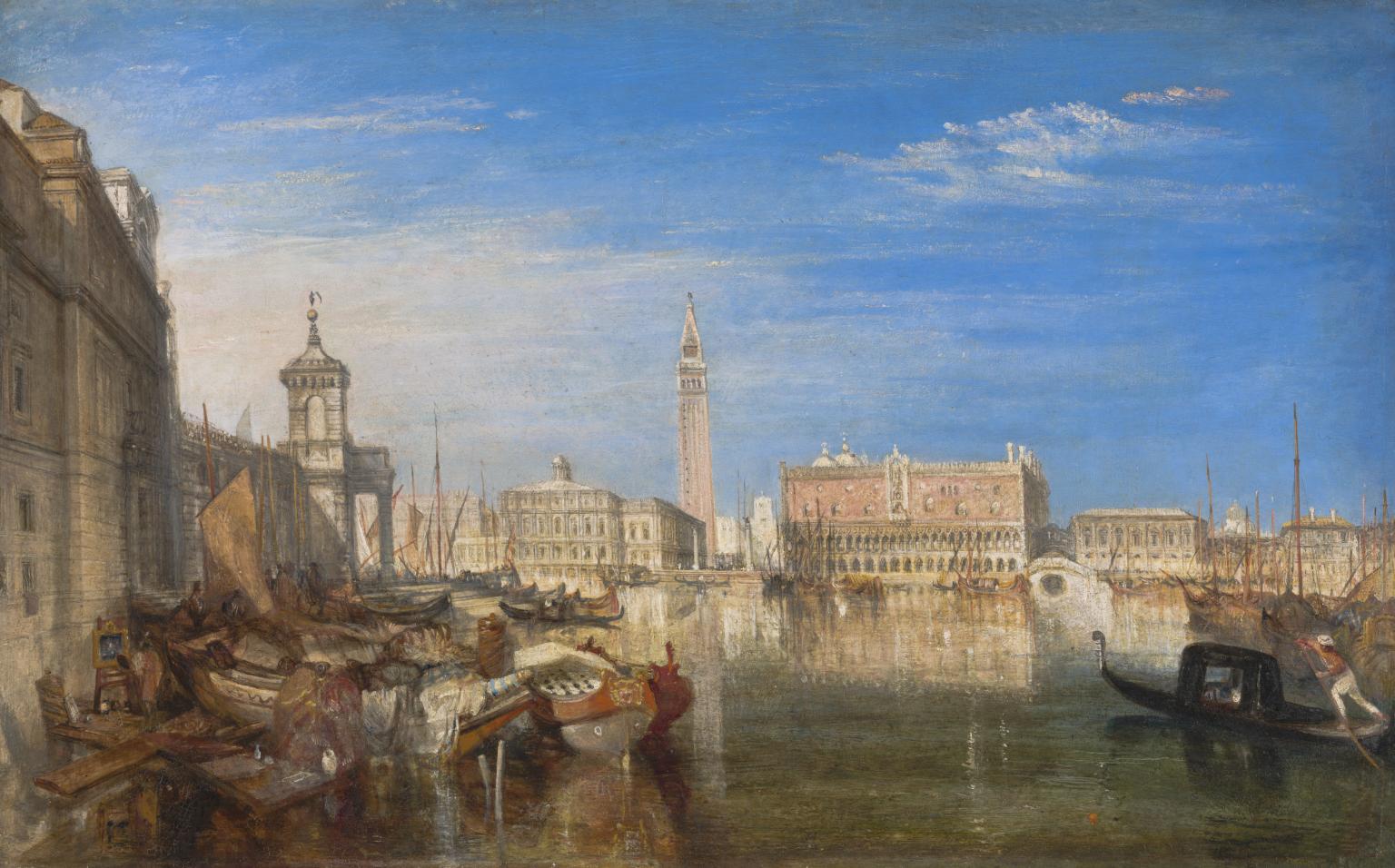
J.M.W. Turner, “Bridge of Sighs, Ducal Palace and Custom-House, Venice: Canaletti Painting,” exhibited at the Royal Academy in 1833, Tate.
What is striking about this commission is its timing. Stanfield was working on his Venetian subjects at precisely the moment that J. M. W. Turner was pursuing the same city with equal intensity. Turner made three visits to Venice, in the late summers of 1819, 1833, and 1840, and his resulting paintings are among the most celebrated of his career. Stanfield had visited in 1831, and the two artists found themselves drawn to many of the same viewpoints. The friendly competition between them came to a head at the Royal Academy exhibition of 1833. Stanfield entered his painting “Venice from the Dogana” into the Royal Academy show that year, and Turner challenged him by painting Bridge of Sighs, Ducal Palace and Customs House, Venice: Canaletti Painting (exhibited 1833; Tate Britain) and entering it into the same exhibition. As van der Merwe notes, if there were a competition, it was a friendly one given that Stanfield considered Turner a friend.
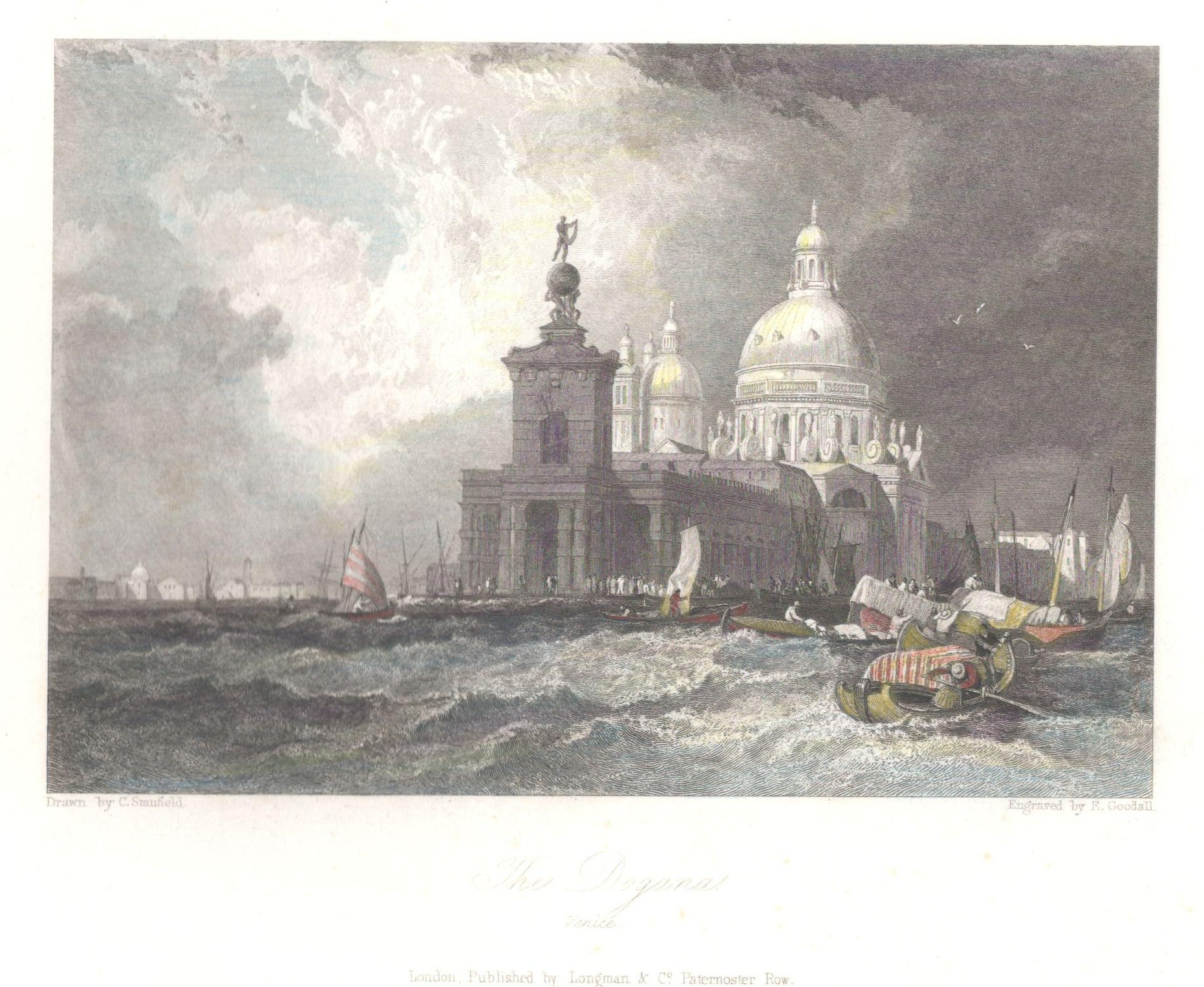
Edward Goodall after Clarkson Stanfield, “Venice from the Dogana,” engraving handcolored in watercolor, c. 1840. Published by Longman’s. Blacklock’s Rare Books, United Kingdom.
Critics widely praised Turner’s work and proclaimed that he had “won” the competition by virtue of his brilliant colors and warm atmosphere. While Turner dissolved forms into light and atmosphere, Stanfield committed to the architectural logic of the scene. Stanfield’s drawing of the Dogana closely relates to a larger watercolor of the same view in the British Museum, dated 1831, which was engraved by E. Goodall for the publication “the time chosen by the artist is during a storm … Woe betide the Gondoliers that have not time to get home before the riot commences! … All Venice is in an uproar!” Although this composition is related to the Bowood painting, it was based on a watercolor by the artist now in the British Museum (illustrated above). It would also later appear at a print engraved by Edward Goodall. Scholars have noted that Stanfield intuitively recognized the visual similarities between the tip of the Dogana and the prow of a ship, a motif that Turner also chose to isolate in his own paintings. It is one of the places where their sensibilities most clearly intersect, even as their methods diverge.
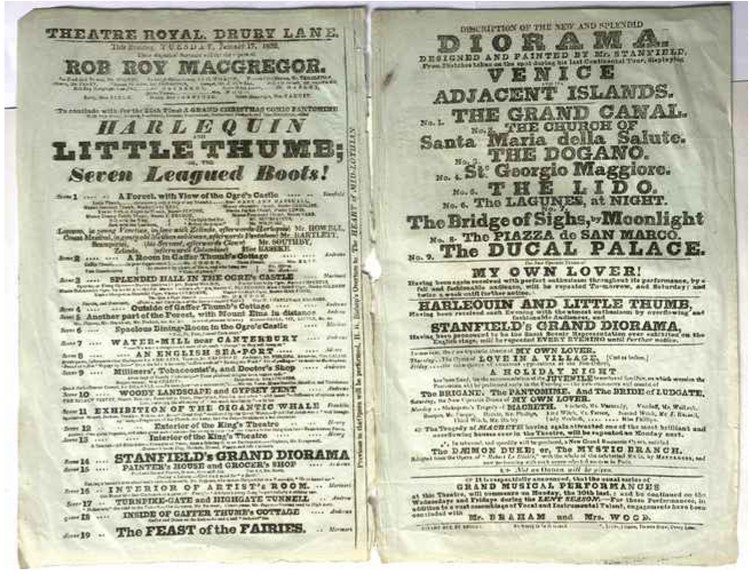
Broadside advertising Stanfield’s diorama of Venice on Tuesday, January 17, 1832. Marlborough Rare Books, London.
Stanfield’s tour up the Rhine and to Venice in the autumn of 1830 had already yielded a celebrated moving panorama, Venice and Its Adjacent Islands (1831). Billed as “the New and Splendid Diorama. Designed and Painted by Mr. Stanfield, From Sketches taken on the spot during his last Continental Tour, displaying Venice and the Adjacent Islands …,” it was 300 feet long and 20 feet high and gas lit. It unrolled through 15 or 20 minutes, complete with stage props and singing gondoliers. Intriguingly, the diorama (as Stanfield called it) was made up of nine separate scenes, listed on the broadside. I wonder how closely these followed the ten views of Venice painted for Bowood? The diorama formed part of the Christmas Pantomime at the Drury Lane in 1831 and into 1832, and it was later repurposed as scenery for The Merchant of Venice. By the time Stanfield turned to Bowood’s walls, the subject was second nature to him, and he was skilled at entertaining a captive audience with views of the city.
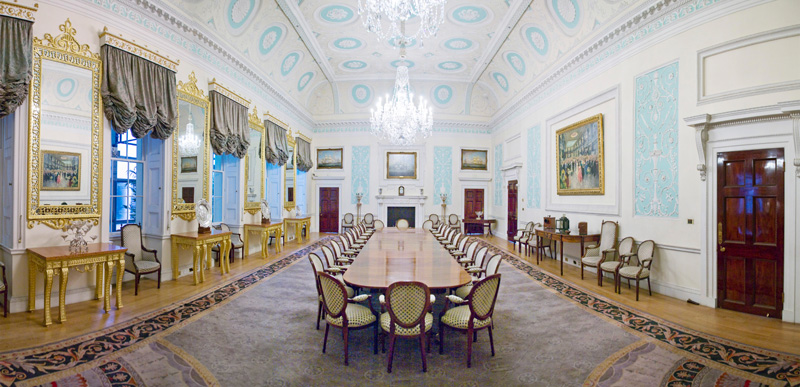
Lloyds of London Image Portfolio Feb2011
At the time of the commission, Bowood House was comprised of a “Big House” and a “Little House” joined by the Great Drawing Room. The Big House did not survive the twentieth century. During World War II it was first occupied by a school, then by the Royal Air Force, after which it was left empty. By 1955, it was so dilapidated that the 8th Marquess demolished it. Before the demolition, the Adam dining room was dismantled and sold: it was bought by Lloyd’s of London, re-installed as the Committee Room in its 1958 building, and subsequently moved in 1986 to the 11th floor of its current building on Lime Street in the City of London. The Adam room, in other words, survives. Stanfield’s paintings of Venice, which once hung within it, were dispersed at the same time, their current whereabouts unknown.
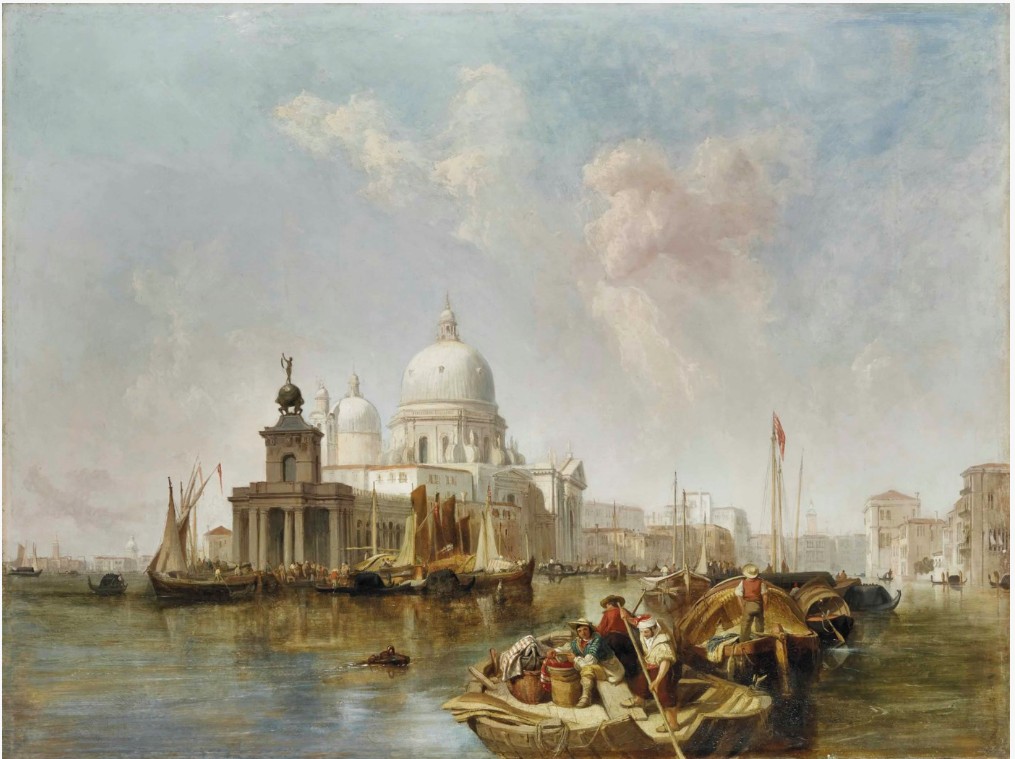
Clarkson Stanfield, “The Punta della Dogana, Venice,” before 1850. Christie’s Paris.
Before I began researching this interior, I assumed that the paintings were still lost, as noted by van der Merwe in his 1979 publication. And yet an auction at Christie’s Paris in 2016 included a view of the Punta della Dogana in Venice by Clarkson Stanfield, with a provenance of they trace back to Bowood House through a sale at Christie’s London May 16, 1952, lot 141. It is likely that the paintings were removed and sold before the demolition of the Big House. Is this the version that decorated Bowood? It is without the storm that would animate the watercolor and engraving versions, which would have been more appropriate for the drama of the diorama than the serenity of the dining room. Perhaps? I’m hopeful that future research can locate Stanfield’s Venetian views destined for Wiltshire.